
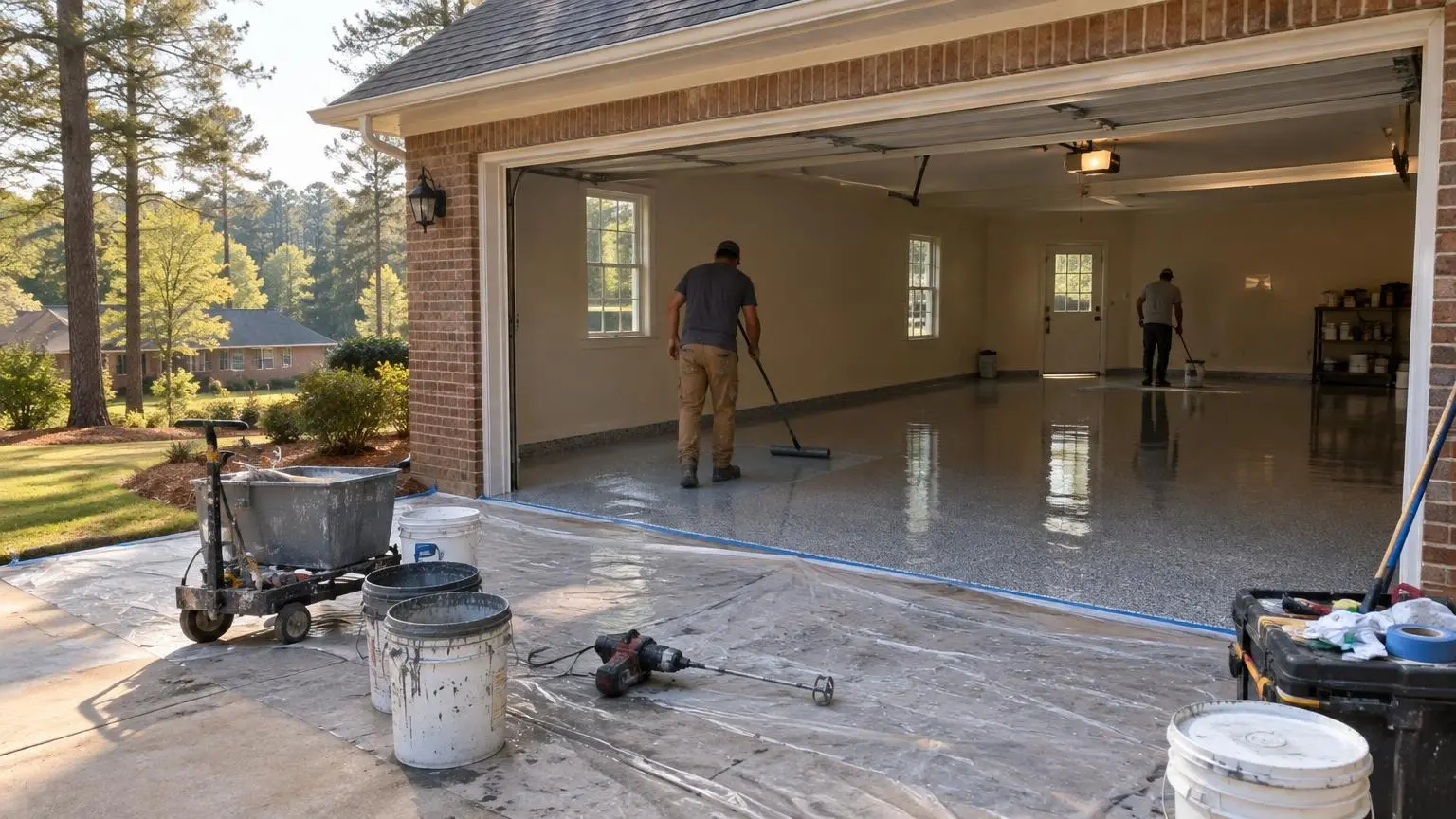
Concrete coatings for a humid Piedmont city
Epoxy Flooring in Atlanta, GA
Garage, basement and business floors planned around Georgia humidity, older slabs and heavy daily use.
- Free on-site estimates, with the floor measured in person
- Moisture testing on the slab before any coating is chosen
- Written quotes that list each prep step, coat and cost
Floors Built for Atlanta Concrete and Atlanta Weather
Atlanta Epoxy Flooring Pros installs epoxy flooring in Atlanta, GA and the towns around it: bungalow garages off intown driveways, three-car garages in the northern suburbs, daylight basements, workshops and busy commercial floors. Every quote starts with the concrete rather than a color card. We look at how old the slab is, how much moisture it gives off, what gets parked, dragged or spilled on it, and how much sun comes through the door. From there we recommend an epoxy floor coating, a polyaspartic system, or a combination, and write the whole plan down before any work begins.
Humidity is the first thing we check
The city sits in a humid subtropical climate. Average relative humidity runs 68.3% across the year and climbs to 74.4% in July and 74.8% in August, while the average July dew point is 67.8 F. That matters on install day. When the surface of a slab is cooler than the dew point, a film of water forms on it that you cannot always see. Resin laid over that film can turn cloudy, develop a greasy surface blush, or bond poorly. So before we open a kit, we take the slab temperature, the air temperature and the dew point. If the gap is too small, we start earlier, run fans and dehumidifiers, or reschedule. Heat is the other half of summer: Atlanta reaches 90 F or more on about 47 days a year, and warm resin sets faster in the bucket and on the floor. We mix smaller batches on hot days so every section goes down while it can still level.
Rain in every month, and what it tracks in
Atlanta averages 50.43 inches of precipitation on about 116 days a year, spread fairly evenly through the seasons. Cars come into the garage wet in January and in July, carrying grit and the clay-like soil the Piedmont region is known for. On those floors we usually suggest a broadcast chip finish or a light texture in the topcoat. It hides dust between cleanings and gives shoes and tires more grip when the surface is wet. A glossy solid color looks sharp, but on a busy family garage it shows every footprint.
Concrete from every era of the city
Atlanta was built in waves, and the slab under your car tells you which one. Eastside streetcar suburbs such as Inman Park and Old Fourth Ward went up between the 1890s and the 1930s, and the Craftsman bungalow is still the most common single-family home in the city's lower density neighborhoods. Collier Heights and Cascade Heights brought postwar suburban layouts, and the metro population grew 28.6% from 2000 to 2010 alone, mostly in low-density subdivisions. Each era brings its own prep work. Older garages often carry layers of paint, oil that has worked its way well into the concrete, patched cracks and no moisture barrier under the slab. Newer slabs may have a curing compound or factory sealer on top that stops a coating from bonding. We diamond grind both kinds to clean, open concrete, fill cracks and joints, and only then pick a primer.
Slopes, basements and the 2009 flood
Atlanta sits in the Appalachian foothills on rolling ground, so many homes have a basement or a garage set into the hill. Those floors deal with groundwater pressure that a flat, raised slab never sees. In September 2009, flooding across the metro caused major damage to some 20,000 homes, businesses and other buildings, and Sweetwater Creek reached its highest level ever recorded. If your lower level has taken water before, we want to know. We moisture test every below-grade floor and, when the readings call for it, switch to a primer rated for higher vapor levels beneath the finish. If a basement has an active leak, we tell you to fix the water first.
Epoxy, polyaspartic, chip or metallic?
Standard epoxy builds a thick, hard layer and bonds well to properly ground concrete. Its weakness is sunlight: HomeGuide's UV grades put epoxy at poor to fair and polyaspartic at excellent, which is why a west-facing garage that bakes every afternoon usually gets a polyaspartic topcoat. Polyaspartic also cures faster, often ready for heavy vehicles in one to two days, against roughly a week for epoxy. Decorative chip systems add color and texture over either base. Metallic epoxy creates a poured, swirled look for basements, home bars and offices. Golf carts, boats on trailers and home workshops are common in metro garages, and each one changes how thick the system should be and which topcoat makes sense.
What epoxy flooring costs
HomeGuide puts professionally installed epoxy flooring at $4 to $10 per square foot nationally, with a two-car garage at $1,600 to $5,800. That guide lists polyaspartic at $5 to $12 per square foot. Where your floor lands depends on the slab: grinding off old paint, crack repair, a moisture-tolerant primer, a full chip broadcast and a thicker topcoat each move the number. For reference, a 20 by 20 foot space works out to 400 square feet, roughly a standard two-bay garage. We measure on site and you get a written, itemized quote, which is the price you pay.
Questions to ask any epoxy flooring contractors you call
When you compare epoxy flooring companies, ask the same questions of each one. How will you prepare the concrete, grinding or acid etching? Do you check the slab for moisture, and with what method? How many coats go down, and is the topcoat epoxy or polyaspartic? What happens if it is too humid on install day? How long before I can walk, move things back, and park? Good epoxy floor installers answer all of that in writing. We put it in every quote so you can compare like with like.
Commercial and industrial floors
Metro Atlanta runs on logistics. Hartsfield-Jackson has been the world's busiest airport by passengers in most years since 1998, Delta runs its largest hub there, UPS operates an air cargo hub on the field, and Norfolk Southern and CSX both run major rail yards in the city. Film production adds stages and shops at studios like Tyler Perry Studios and Pinewood Atlanta. Floors in warehouses, service bays, kitchens and production spaces need thicker, chemical-resistant concrete floor coating systems with safety striping. We plan those jobs in phases so a business can keep part of the space working.
Coating Systems We Install
Six concrete coating systems, each matched to the slab, the room and the way you use it.
Epoxy Garage Floors
A ground, moisture-tested garage slab with an epoxy base and a sun-tough topcoat, sized to what you park and store.
Learn more →Decorative Chip Flooring
Vinyl flake scattered into wet resin and locked under a clear coat, for texture, color and a floor that hides Georgia grit.
Learn more →Polyaspartic Coatings
Fast-curing, UV-stable polyaspartic floor coating for sunny garages and floors that cannot be out of service for a week.
Learn more →Metallic Epoxy Floors
Poured metallic epoxy with movement and depth, for basements, home bars, offices and retail floors.
Learn more →Commercial Epoxy Flooring
Thicker, chemical-resistant concrete floor coating for warehouses, shops, kitchens and production spaces, phased around your hours.
Learn more →Basement Floor Coatings
Moisture-tested basement floor coating for sloped-lot lower levels, rec rooms, laundry rooms and storage.
Learn more →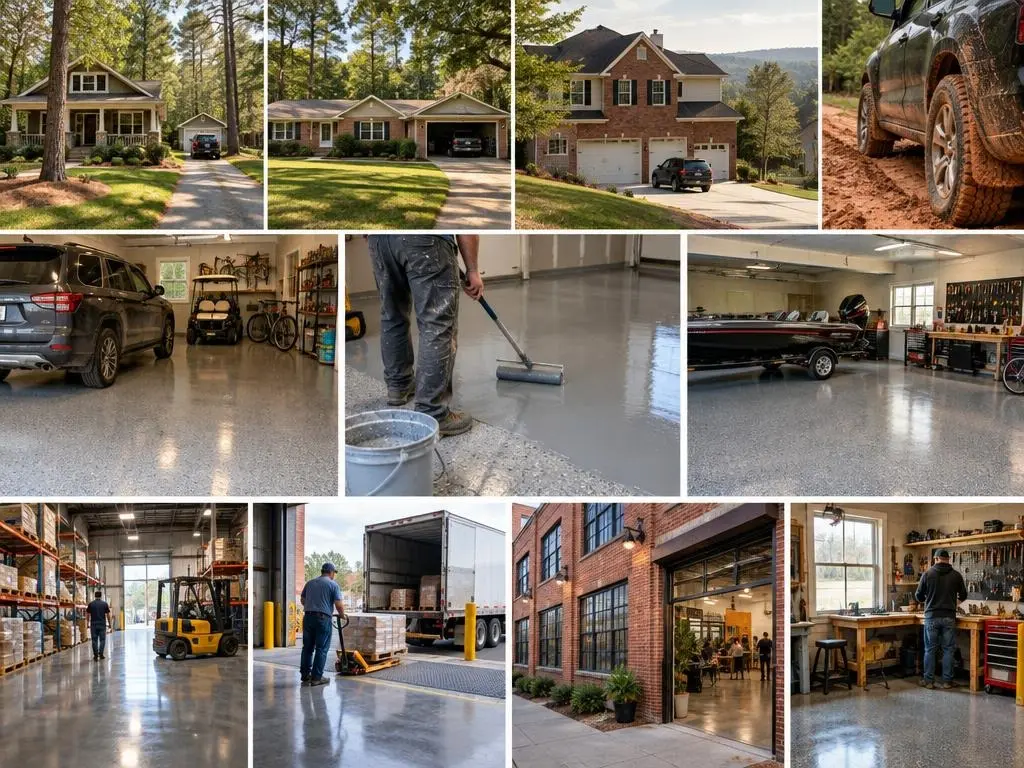
Why Homeowners Call Atlanta Epoxy Flooring Pros
Moisture readings before a price
We test the slab at the estimate, so the system and primer in your quote match what the concrete is actually doing.
Dew point checked on install day
Before every coat we take slab temperature, air temperature and dew point readings, and we pause when Atlanta humidity puts the bond at risk.
Ground, not etched
Floors are diamond ground to open the concrete, then patched and vacuumed. That surface is what the coating holds on to.
Everything in writing
Your quote lists the system, every coat, each prep step and the total. If the job turns up something new, you sign off on it in writing before we proceed.
Common Questions
What would epoxy cost on a 20x20 floor?
Twenty feet by twenty feet comes to 400 square feet, which is in two-car garage territory. HomeGuide lists two-car garage epoxy at $1,600 to $5,800 and installed epoxy at $4 to $10 per square foot. Old paint, cracks, moisture and a chip or polyaspartic finish all move the price, so we measure and test first and give you a written quote.
What is the price range for 1,000 or 1,500 square feet of epoxy?
Larger floors are usually priced per square foot, and HomeGuide puts installed epoxy nationally between $4 and $10 a foot. Commercial systems with 100% solids resin start around $12 per square foot according to HomeAdvisor. On big floors, grinding hours, repairs and layer count matter more than the resin itself, which is why we quote each one on site.
Does epoxy flooring have drawbacks?
Standard epoxy can yellow or chalk in direct sun, it takes days to fully cure, and a smooth gloss finish gets slippery when wet. It also fails if it is laid over damp or poorly prepared concrete. We deal with those by testing for moisture, grinding the slab, adding texture or flake, and using a polyaspartic topcoat where sunlight reaches the floor.
Can you install epoxy during an Atlanta summer?
Yes. Summer dew points here average in the upper 60s, so we check slab temperature against the dew point before each coat, often start early in the day, and mix smaller batches when it is hot. If conditions are too close, we reschedule rather than risk a cloudy or weak bond.
Should my garage get epoxy or polyaspartic?
If sunlight hits the floor through an open door, a polyaspartic topcoat is the safer choice because it holds up to UV far better than epoxy. A frequent Atlanta garage recipe is thick epoxy underneath with polyaspartic on top to take the sun and the scuffing. We explain the options at the estimate.
When is a fresh coating ready for cars?
That comes down to the product and the weather. HomeGuide says polyaspartic typically handles heavy vehicles within 24 to 48 hours, whereas epoxy may need close to a week before it is fully hard. On install day we hand you separate times for walking, furniture and parking.
Do you coat basement floors?
Yes. Basements get a moisture test first, since below-grade slabs on sloped Atlanta lots can push water vapor up through the concrete. High readings mean we lay down a vapor-tolerant primer first, and if water is getting in, the leak has to be solved before any coating.
Towns Across Metro Atlanta
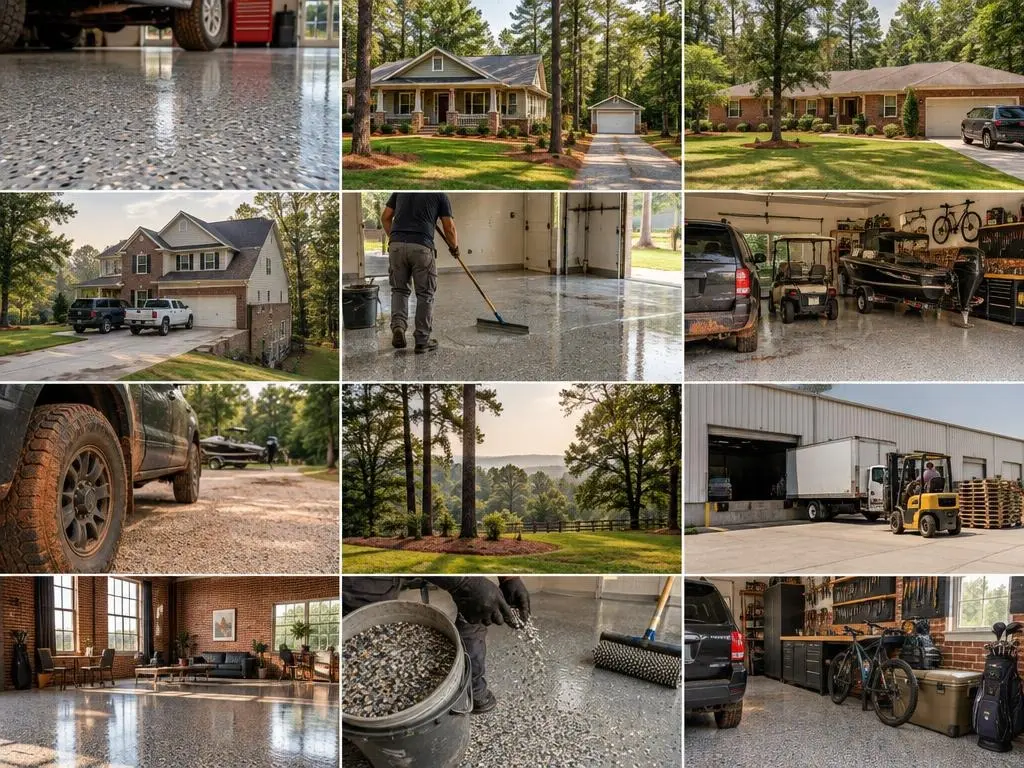
We work across the city of Atlanta, including Buckhead, and in the suburbs around it. North of the city that means Sandy Springs, Dunwoody, Brookhaven, Roswell, Alpharetta, Johns Creek, Milton, Peachtree Corners, Duluth, Suwanee, Lawrenceville and Cumming. To the east we cover Decatur and Tucker. In Cobb and Cherokee counties we work in Marietta, Smyrna, Kennesaw, Woodstock and Canton, and to the west and south in Douglasville, Newnan, Fayetteville and Peachtree City. Each town has its own page with the local conditions we plan for, from lake-house boat garages near Lanier to golf cart garages on Peachtree City's path network.
- Epoxy Flooring in Atlanta, GA
- Epoxy Flooring in Buckhead, GA
- Epoxy Flooring in Sandy Springs, GA
- Epoxy Flooring in Dunwoody, GA
- Epoxy Flooring in Brookhaven, GA
- Epoxy Flooring in Decatur, GA
- Epoxy Flooring in Roswell, GA
- Epoxy Flooring in Alpharetta, GA
- Epoxy Flooring in Johns Creek, GA
- Epoxy Flooring in Milton, GA
- Epoxy Flooring in Marietta, GA
- Epoxy Flooring in Smyrna, GA
- Epoxy Flooring in Kennesaw, GA
- Epoxy Flooring in Peachtree Corners, GA
- Epoxy Flooring in Duluth, GA
- Epoxy Flooring in Lawrenceville, GA
- Epoxy Flooring in Suwanee, GA
- Epoxy Flooring in Tucker, GA
- Epoxy Flooring in Peachtree City, GA
- Epoxy Flooring in Fayetteville, GA
- Epoxy Flooring in Newnan, GA
- Epoxy Flooring in Douglasville, GA
- Epoxy Flooring in Canton, GA
- Epoxy Flooring in Woodstock, GA
- Epoxy Flooring in Cumming, GA
Get Your Free Atlanta Floor Estimate
Our visit covers measuring and a slab moisture check, and the price arrives as a written quote. Phone (470) 873-8205 or use the form.